Amazing Facts about Mountain Gorillas
In this guide, you’ll learn all about Uganda’s mountain gorillas — their diet, habitat, social structure, and fascinating behaviors.
You’ll also discover unique facts about silverbacks, females, and baby gorillas, and why these gentle giants make Uganda one of the world’s most extraordinary wildlife destinations.
Where to Find Uganda’s Mountain Gorillas
Uganda is one of only three countries in the world where mountain gorillas live in the wild.
You can find them in:
- Bwindi Impenetrable Forest National Park — home to the largest population of mountain gorillas
- Mgahinga Gorilla National Park
More than half of the world’s remaining mountain gorillas live in Uganda — making it a must-visit destination for gorilla trekking adventures in the “Pearl of Africa.”
Origin of the Name “Gorilla”
The word Gorilla comes from the Greek term Gorillai, meaning “hairy women.”
They are among the largest living primates and share a remarkable 98–99% of their DNA with humans, making them our closest relatives after chimpanzees.
Conservation Status
Mountain gorillas are listed as Critically Endangered by the IUCN due to:
- Habitat loss from land development
- Poaching (especially the illegal pet trade for baby gorillas)
- Civil unrest in their habitats
- Illegal charcoal burning
Despite these threats, conservation efforts in Uganda have helped stabilize and even grow gorilla populations.
Life Stages of a Gorilla
| Stage | Age Range | Description |
|---|---|---|
| Infant | 0–3 years | Dependent on mother |
| Juvenile | 3–5 years | Learns social behavior through play |
| Sub-Adult | 5–9 years | Not yet breeding |
| Adult Female | 9+ years | Reaches sexual maturity |
| Blackback Male | 9–12 years | Young, non-dominant male |
| Silverback | 12+ years | Mature dominant male with silver hair on back |
The Silverback — Leader and Protector
A silverback is the dominant adult male in a gorilla family group.
He leads the troop, decides when to eat, move, and rest, and protects his family from danger.
- Strength: Can lift up to 10 times his body weight
- Weight support: Can hang from one arm holding up to 400 lbs
- Role: Father, leader, and peacekeeper
Behavior and Temperament
Although they appear powerful and intimidating, mountain gorillas are gentle and shy by nature.
They are often referred to as “gentle giants.”
- They only become aggressive when threatened.
- A mother will fight to the death if her baby is in danger.
- Displays of aggression include chest beating, grunting, and roaring.
You Won’t Find Them in Zoos
Mountain gorillas do not survive in captivity.
Gorillas seen in zoos are usually lowland gorillas from western Africa.
Mountain gorillas can only thrive in their natural, high-altitude forest homes in Uganda, Rwanda, and the Democratic Republic of Congo.
Emotions and Social Life
Mountain gorillas laugh, cry, and play much like humans.
They show deep emotional intelligence and strong family bonds.
- Babies giggle when tickled.
- They play together like human children.
- They form lifelong relationships within their troop.
A typical troop consists of 5–30 members, led by one silverback and several females with their offspring.
Physical Adaptations
Mountain gorillas differ from other gorilla subspecies in several ways:
- Thicker, darker fur to withstand cold mountain climates
- Shorter arms, but larger jaws, teeth, and noses
- Spend most of their time on the ground rather than in trees
Communication
While they don’t speak, gorillas communicate through a variety of sounds and gestures:
- Grunts, barks, hoots – social communication
- Chest beating, screams, roars – alarm or dominance
- Belching – sign of contentment
Each gorilla has unique nose prints, similar to human fingerprints — a feature used by researchers to identify individuals.
Female Gorillas
- Reach sexual maturity around 10 years old
- Usually give birth to one baby (twins are rare)
- Nurse and care for infants for up to 6 years
- Have about 4–6 offspring in their lifetime
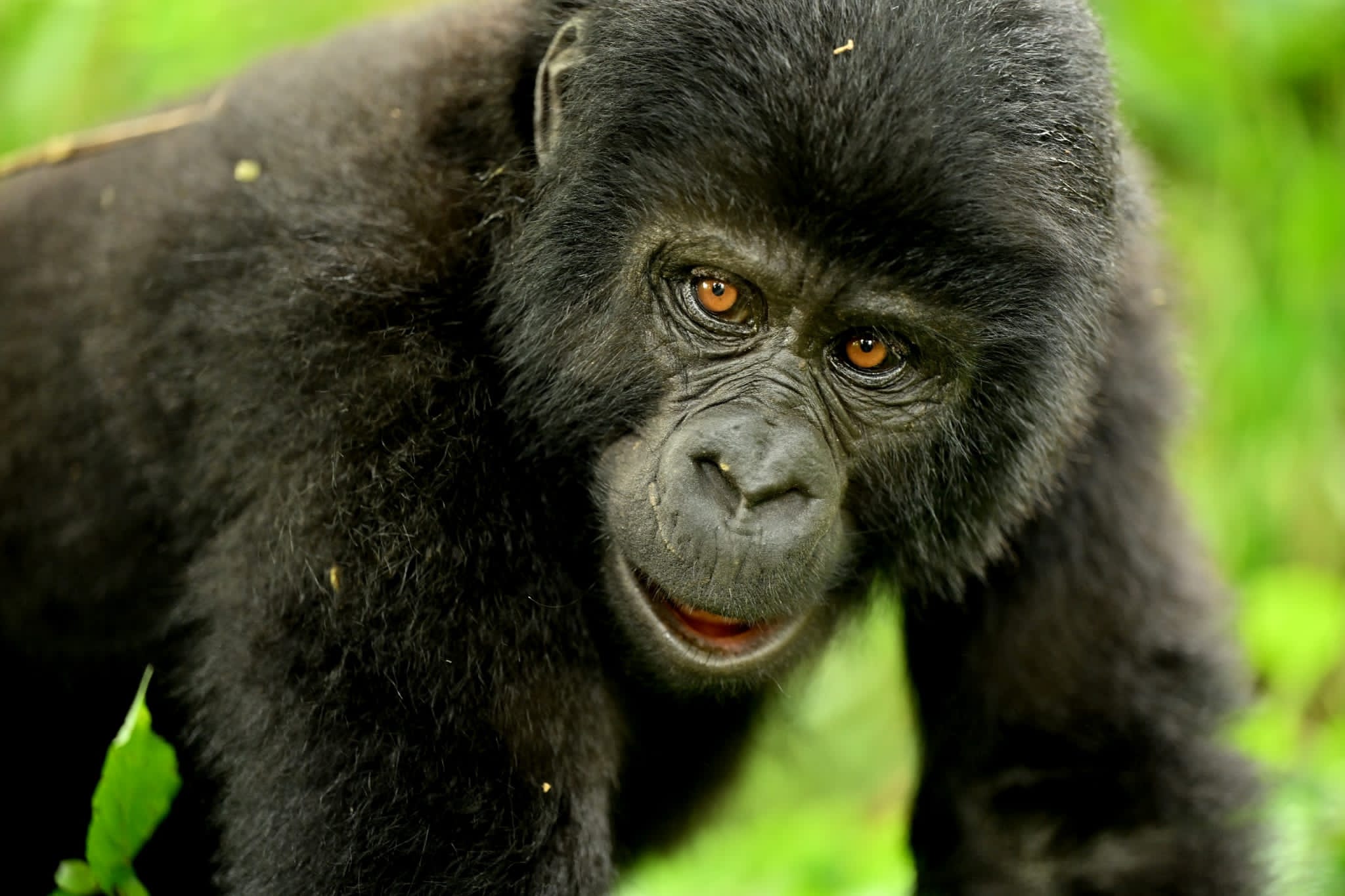
Facts About Baby Gorillas
- Weigh about 1.8 kg (4 lbs) at birth
- Can sit upright at 3 months
- Spend their first 4 years nursing and clinging to their mothers
- Learn social skills through play and imitation
Intelligence and Tool Use
Mountain gorillas are highly intelligent and capable of using tools:
- Sticks to pull insects or check water depth
- Branches to cross streams
- Leaves and vines to build nests for sleeping
They are observed solving problems and learning from experience.
Diet
Gorillas are mostly vegetarian.
Their diet includes:
- Bamboo
- Thistles
- Wild celery
- Fruits
- Occasionally insects
They eat for up to five hours per day, consuming about 40–50 pounds of food daily.
Because their food contains a lot of moisture, they rarely need to drink water.
Nomadic Lifestyle
Mountain gorillas are nomadic — they move several kilometers each day in search of food.
They build new nests each night from leaves and branches to sleep in, and also take midday naps.
Daily Routine
Mountain gorillas are creatures of habit:
- 6:00 a.m. – Wake up and begin foraging
- Midday – Rest and nap
- Afternoon – Forage again
- 6:00 p.m. – Settle down and build new nests for the night
Gorilla Health and Protection
Because they share so much DNA with humans, gorillas can catch human illnesses like colds and flu.
Veterinary teams monitor them regularly for parasites, disease, and injuries.
To protect them:
- Only a limited number of visitors are allowed per day.
- Strict hygiene and distance rules are enforced during treks.
Size and Strength Records
- Tallest Silverback: 6 ft 4 in
- Heaviest Recorded: 585 lbs
- Current Largest Living: “Guhonda” from Volcanoes National Park, Rwanda — weighs around 225 kg (496 lbs)
Fascinating Facts at a Glance
- 🦍 Gorillas share 98–99% DNA with humans
- 👃 Each has a unique nose print
- 👨👩👧 They live in family troops of up to 30 members
- 💀 Their only natural predator is humans
- ⏳ Life expectancy: 40–50 years

All Categories
Recent Posts